
| Date of decision: | 23 January 2026 (APO); 15 April 2026 (FCA) |
| Body: | Australian Patent Office; Federal Court of Australia |
| Adjudicator: |
Delegate Felix White (APO); Perram J (FCA) |
Introduction
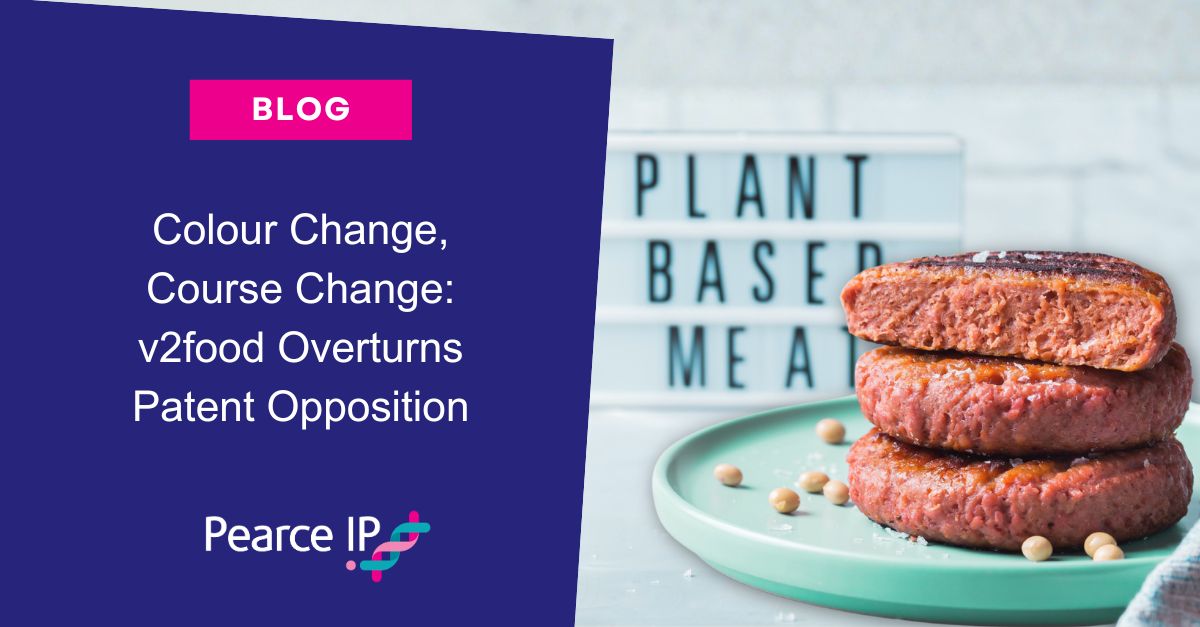
These decisions concern Australian Patent Application No. 2021247417 (“Food Colouring Agents”), in the name of v2food Pty Ltd. The application relates to the use of phycoerythrin – a protein obtainable from algae including Porphyridium and Rhodomonas species – as a colouring agent in meat mimetic (plant-based meat) products, capable of mimicking the colour change that occurs when animal meat is cooked. The matter proceeded first before a delegate of the Commissioner of Patents at the Australian Patent Office (APO), and then on appeal to the Federal Court of Australia before Justice Perram.
Background
v2food’s patent application describes the application of phycoerythrin to impart a pink or red colour to meat mimetic products that visually changes upon cooking to an internal temperature of approximately 50–95°C, thereby closely replicating the appearance of cooking real meat. Existing plant-based colouring agents such as beetroot extract are noted to lack this heat-responsive colour-change property.
The application was accepted in August 2023 and Provectus Algae Pty Ltd filed a notice of opposition in November 2023, raising multiple grounds of opposition including lack of novelty, inventive step, clarity, best method, sufficiency and support. The opposition was heard by Delegate Felix White in Melbourne in May 2025 (Provectus Algae Pty Ltd v v2food Pty Ltd [2026] APO 1).
Key Issues
At the APO, the Delegate narrowed the live issues to novelty, inventive step, clarity, best method, sufficiency, and support. Priority was also contested, as its validity affected which prior art documents could be relied upon.
The Delegate found that the priority date of 31 March 2020 was validly claimed, which limited the available prior art. On novelty, the Delegate found that none of the cited documents contained a clear and unmistakeable direction to use phycoerythrin derived specifically from Porphyridium or Rhodomonas in meat mimetics, and so the opposition on the novelty ground failed. All other grounds of opposition also failed, except inventive step.
On inventive step, the critical question became whether a skilled worker in the field of meat mimetics, equipped with common general knowledge and either of two single prior art documents – D17 (concerning Rhodomonas salina phycoerythrin) or D18 (concerning, relevantly, Porphyridium cruentum phycoerythrin) – would have been led, as a matter of routine, to use those proteins to achieve a cooking-dependent colour change in meat mimetics. The decision is notable because the Delegate treated D17 and D18 as single pieces of prior art information under post-Raising the Bar s 7(3)(a), even though they were outside the skilled worker’s technical field. Each document disclosed that the relevant phycoerythrins lose absorption/emission in the 500-600 nm region at temperatures of approximately 60-80°C in aqueous/in vitro conditions.
Considerations
Person Skilled in the Art
A central issue in the APO decision was identifying the appropriate “person skilled in the art” — the hypothetical, non-inventive expert by whose knowledge novelty and inventive step are assessed. The Delegate made an important distinction between the skilled person for construing the specification (relevant to sufficiency and support) and the skilled person for assessing novelty and inventive step. Because the invention married two different technical fields — algal biochemistry and food technology — these could be different people.
From this, the Delegate drew a deliberate distinction between two different skilled person constructs:
- For construing the specification and assessing sufficiency and support, the skilled addressee would need expertise in both algal protein biochemistry and food technology, because understanding the full disclosure of the specification required knowledge of both fields.
- For assessing novelty and inventive step, the relevant skilled worker was confined to the field of food technology, specifically meat mimetics, because that is the field to which the invention is directed — the problem being solved (replicating the colour change of cooking meat) is a food technology problem, not an algal science problem.
This distinction limited the common general knowledge available for the inventive step analysis to what a meat mimetics specialist would know; it did not itself import algal biology or marine science as common general knowledge. However, the Delegate also held that, under the post-Raising the Bar form of s 7(3)(a), a single prior art document may be considered with common general knowledge even if the document is outside the skilled worker’s technical field. The distinction also shaped the weight given to the expert evidence, with the algal biotechnologists’ evidence carrying less weight on inventive step, and the applicant’s meat mimetics expert, Dr Ha, treated as the best placed witness for that purpose.
The Delegate accepted that the problem of providing a meat analogue with a realistic cooking-related colour change was part of common general knowledge in the field, referencing a 2019 review article (D39) on commercially available meat analogue products.
Inventive Step
The core of the lack of inventive step argument pressed by the Opponent at the oral hearing was that the choice of Porphyridium or Rhodomonas phycoerythrin to provide a colour change to meat mimetics was an obvious solution to the problem of providing a meat mimetic with a suitable indicator for colour change upon cooking, based on the known absorbance and denaturation properties of these proteins. In essence, the Opponent asserted that the route taken by the inventors, as disclosed in the specification, was an obvious one.
The Delegate found that it was not objectively surprising that phycoerythrin would work as a colouring agent in meat mimetics. The Delegate noted that the problem was to find a red pigment that loses colour at cooking temperatures. Prior art documents D17 and D18 showed that phycoerythrin from Rhodomonas and Porphyridium had that property, losing colour in the relevant temperature range. Although those experiments were performed in solution, the Delegate considered that sufficiently close to the wet or semi-solid environment of a meat mimetic matrix.
The Delegate was not persuaded by v2food’s arguments that the underlying mechanism was different from meat — thermal denaturation rather than oxidation — because the skilled person was a food technologist looking for colour-change performance, not a scientist focused on theoretical mechanisms. There was also no persuasive evidence that the meat mimetic matrix would prevent phycoerythrin from denaturing and changing colour.
The Delegate gave less weight to the views of the algal biotechnology experts because the relevant skilled person for inventive step was a meat mimetics/food technology specialist, not an algal biotechnologist.
Accordingly, the Delegate held that the skilled worker would have had a reasonable expectation that phycoerythrin from Porphyridium or Rhodomonas “may well” work to provide cooking-related colour change in meat mimetics. The need for further validation did not avoid obviousness, because Australian inventive step law does not require certainty of success — only an expectation that the proposed approach may well succeed.
The Delegate concluded that all 24 claims lacked an inventive step in light of common general knowledge combined with either D17 or D18 as single prior art documents. A key aspect of the APO decision was the Delegate’s willingness to rely on single technical papers outside the skilled worker’s field as s 7(3)(a) information.
Clarity
The opponent argued that claim 1 contained internal inconsistencies because not all Porphyridium species produce red phycoerythrin and not all phycoerythrins change colour across the full 50–95°C range claimed. The Delegate rejected this argument, finding that the claim was self-limiting — phycoerythrins that did not meet the stated performance criteria (colour change within the specified temperature range) simply fell outside the claim’s scope, and a skilled worker could readily determine whether any given phycoerythrin satisfied those criteria.
Best Method
The opponent argued that v2food had withheld a better method of formulating phycoerythrin into meat mimetics than that disclosed in the specification, pointing to an internal email describing early experiments with Porphyridium purpureum phycoerythrin. The Delegate found that the language of the email — referring to having “had a play” and results “taking it in the right direction” — clearly indicated these were preliminary experiments rather than a superior undisclosed method, and the specification’s examples were broadly consistent with those experiments in any event.
Sufficiency
The opponent contended that the wide range of variables in the claims — different phycoerythrin types, different Porphyridium and Rhodomonas species, and different meat mimetic matrices — combined with expert evidence that validation would be needed for each product, indicated an undue burden on the skilled worker. The Delegate applied the Jusand approach of only interrogating variables “relevant” to the technical contribution, finding that the core technical contribution was simply the ability to achieve a cooking-dependent colour change, and that variability in product formulation or phycoerythrin type did not undermine that contribution across the claim scope.
Support
The opponent’s submissions on support were brief, essentially arguing that because the claims lacked novelty there was no technical contribution and therefore the claims could not correspond to any technical contribution. Having found that the application did have a genuine technical contribution — the use of suitable phycoerythrins from Porphyridium and/or Rhodomonas to confer a cooking-dependent colour change to meat mimetics — and that this was properly reflected in the claims, the Delegate found the support ground was not made out.
Conclusion
In the APO decision, the opposition succeeded because all claims were found to lack an inventive step. The Delegate invited submissions on whether v2food should be given an opportunity to amend and made no award of costs. V2food appealed the decision.
The Appeal
On appeal to the Federal Court (v2food Pty Ltd v Provectus Algae Pty Ltd [2026] FCA 436), the outcome changed significantly. Provectus filed a submitting notice in March 2026, but had filed no evidence in the Federal Court proceedings. The Commissioner similarly declined to take an active role in the appeal proceedings. As a result, there was no evidentiary material before the Court capable of supporting any ground of opposition.
Perram J applied well-established principles confirming that an appeal under section 60(4) proceeds as a hearing de novo, with the opponent bearing the onus of establishing grounds of opposition. Where, as was the case here, the opponent has filed no evidence and taken no active part, there is no basis on which the opposition can be upheld. His Honour distinguished CSIRO v Urrbrae Foods [2025] FCA 1591, where Beach J had invited the patent applicant to file additional evidence because the delegate’s finding of invalidity had rested on a gap in the applicant’s own evidence rather than the opponent’s evidence. In this matter, the invalidity finding at the APO arose from Provectus’s evidence on inventive step – evidence that was absent before the Court on appeal. Perram J therefore did not need to, and did not, engage with v2food’s substantive criticisms of the Delegate’s inventive step reasoning.
Outcome
The Federal Court allowed the appeal, set aside the Delegate’s decision of 23 January 2026, dismissed Provectus’s opposition, and ordered that the patent application proceed to grant. No order as to costs was made, consistent with the orders proposed by v2food.
Implications
The Federal Court decision reinforces an important principle in Australian patent opposition appeal practice, namely, where an opponent files a submitting notice and adduces no evidence on appeal, that will generally be fatal to the opposition if the delegate’s adverse finding depended on the opponent’s evidence: the opponent bears the onus and cannot discharge it without evidence.
For patentees and opponents in the food technology and alternative protein sectors, the outcome of these decisions is commercially significant but should be framed carefully. v2food’s application proceeded to grant, but the Federal Court outcome was the result of a procedural decision rather than a substantive review of the Delegate’s inventive step analysis. Perram J also confirmed that grant does not foreclose future validity challenges, leaving open the possibility of revocation proceedings. The APO decision nevertheless remains useful because it illustrates how single scientific papers outside a skilled worker’s field may be used as s 7(3)(a) prior art in a post-Raising the Bar inventive step analysis.
About Pearce IP
Pearce IP is a privately owned/independent, specialist, life-sciences focussed, intellectual property/law firm offering lawyers and attorneys in Australia and New Zealand.
Our lawyers and attorneys specialise in pharma, biopharma, biotech, ag-tech, food-tech, med-tech, although our work is broader than these industries.
Pearce IP and its leaders are ranked in every notable legal directory including: Chambers & Partners, Legal 500, IAM Patent 1000, IAM Strategy 300, MIP IP Stars, Doyles Guide, WTR 1000, Best Lawyers, WIPR Leaders, Best Law Firms, among others. In 2025, Pearce IP was honoured by Australasian Lawyer and New Zealand Lawyer as a Top Specialist Firm, 5 Star Employer of Choice, and the “Standout Winner” for Inclusion and Culture (<100 employees).
Pearce IP is the only leading IP firm in Australia and New Zealand with a female founder, and is certified by WEConnect International as women owned.

Sally Paterson
Executive, Lawyer (NZ), Patent & Trade Mark Attorney (AU, NZ)
Sally is a senior Trans-Tasman Patent and Trade Mark Attorney, and a New Zealand registered lawyer with over 20 years’ experience in IP. Sally’s particular expertise is in life sciences, drawing from her background in biological sciences. Sally is well respected in the New Zealand IP community for her broad ranging skills in all aspects of intellectual property advice, protection and enforcement. Sally has extensive experience securing registration for patents, designs and trade marks in New Zealand, Australia and internationally, providing strategic infringement, validity and enforceability opinions, acting in contentious disputes including matters before the courts of New Zealand and before IPONZ and IP Australia, and advising on copyright and consumer law matters.

Donna Meredith
Associate, Patent & Trade Mark Attorney
Donna is a Patent and Trade Mark Attorney with more than 8 years’ post-qualification experience, and a background in biotechnology and biology.
Donna supports Australian and international clients in a range of life sciences fields including nanoparticles, pharmaceuticals, biopharmaceuticals, biotechnology, DNA sequencing, cell and gene therapy, CRISPR technologies, protein chemistry, formulation chemistry, chemical compounds, biofuels, plant varieties, ag-tech, food-tech and medical devices.

Helen Macpherson
Executive, Lawyer (Head of Litigation –Australia)
Helen is a highly regarded intellectual property specialist and industry leader with more than 25 years’ experience advising on patents, plant breeder’s rights, trade marks, copyright and confidential information. She is known for her expertise in complex, high-value patent matters and leverages her technical background in biochemistry and molecular biology to work across a wide range of technologies, including inorganic, organic, physical and process chemistry, biochemistry, biotechnology (including genetics, molecular biology and virology), and physics. Helen is an active member of the Intellectual Property Committee of the Law Council of Australia and the Intellectual Property Society of Australia and New Zealand.